Navigating Market Volatility with a Clearer Lens
TL;DR
Recent geopolitical tensions and policy headlines have created short‑term noise, but the underlying fundamentals remain stable. The US dollar’s 10% decline in early 2025 is well within historical norms, and currency movements have played a major role in shaping reported equity returns. A weaker dollar often boosts overseas earnings for US companies and can enhance international investment performance. Staying focused on long‑term drivers, not headlines, is key to navigating periods of volatility.
Navigating Market Volatility with a Clearer Lens
The early part of the year has been unusually dense with geopolitical and policy‑driven developments. From tensions involving Venezuela and Iran to unconventional policy proposals emerging from Washington, investors have been confronted with a steady stream of attention‑grabbing headlines. It’s the kind of environment that can easily distort perspective if you’re watching markets too closely.
At AI Wealth, we view these moments not as anomalies but as reminders of how frequently short‑term noise competes with long‑term fundamentals.
The Dollar’s Movement in Context
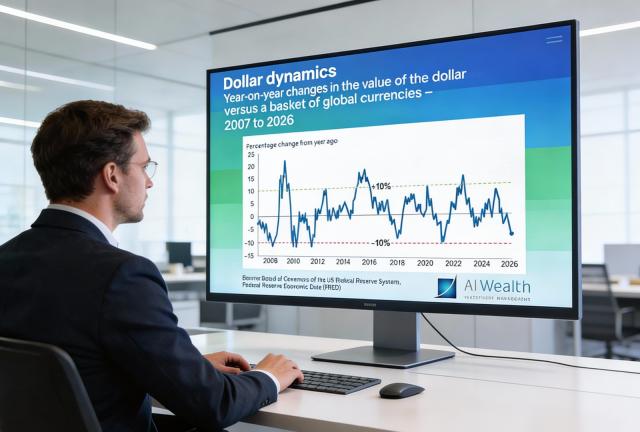
One of the most discussed themes so far has been the weakening US dollar. Since the beginning of 2025, the dollar has slipped nearly 10% against a broad basket of global currencies. For many, that feels like a meaningful shift. Historically, however, this sits comfortably within the currency’s normal range. Over the past two decades, swings of around 10% in either direction over a 12‑month period have been entirely routine.
Understanding this context is essential. Currency moves can significantly influence investment outcomes, often in ways that aren’t immediately obvious. For example, UK investors saw strong headline returns from European equities in 2025, but almost 40% of those gains were driven by currency strength rather than underlying market performance. Once adjusted, European and US equity returns looked far more similar than the headlines implied.
Currency dynamics also play a direct role in corporate profitability. Roughly 40% of S&P 500 revenues come from outside the United States. When the dollar weakens, those overseas earnings translate into higher reported profits. Global sectors such as technology, communications and raw materials tend to feel this effect most strongly.
Why Perspective Matters More Than Headlines
A softer dollar is not inherently a negative signal. In many cases, it supports earnings growth and enhances returns from international markets. And despite the current noise, the dollar remains anchored by the scale of the US economy, the depth of its financial markets and its central role in global trade. These structural advantages do not shift because of a few turbulent weeks.
The real challenge for investors is resisting the urge to respond to every headline. Markets have always been noisy. They always will be. What separates successful long‑term investors from reactive ones is the ability to stay grounded, understand the forces that genuinely matter and maintain discipline when sentiment becomes unsettled.
At AI Wealth, we help clients navigate periods like this with clarity and confidence. If you’d like to review your portfolio positioning or discuss how currency movements may influence your long‑term strategy, we invite you to reach out to your adviser.